
The Habit
Thirty days. One tool. Real fluency.
Here’s the pattern I keep seeing. A guy hears AI is a big deal. He signs up for ChatGPT or Claude. He plays with it for an evening, asks it to write a poem about his dog, asks for a recipe, asks something philosophical to see what happens. He’s mildly impressed. He closes the tab. Two weeks later, he’s forgotten he has an account. I get it. I’ve bought gear with less follow-through than that, and at least the chatbot doesn’t take up space in the garage.
This is the most common AI experience among grown men, and it’s why most of them are convinced AI isn’t going to change much for them. They’ve tried it. It was fine. Moving on.
Here’s what they’re missing. Trying AI is not the same as getting useful with AI. The first one is a parlor trick that takes an evening. The second one is a skill that takes a habit. Without the habit, all you have is the parlor trick, and parlor tricks fade fast.
Skill comes from frequency, not intensity. A man who uses AI for five minutes a day for a month will be more capable than a man who watches forty hours of YouTube about it.
The 30-day rule
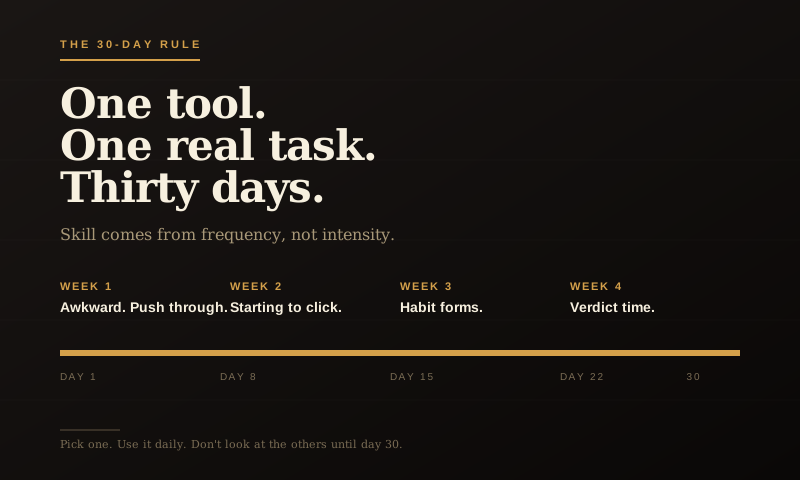
If you want to genuinely figure out whether AI is useful for your life, commit to thirty days of using one tool, your pick, for one real task per day.
That’s the whole framework. Not heavy. Not theoretical. One real task. Thirty days.
By day thirty, one of two things will have happened. Either you’ll have built a tool you actually rely on, or you’ll have a clear-eyed sense of what AI does and doesn’t do for your specific life. Both outcomes are valuable.
What counts as a “real task”
Not “write me a poem about my dog.” Not “explain quantum physics.” Real tasks are things you would actually have done anyway, where AI helps with the actual work.
Examples:
- Drafting an email you’ve been putting off.
- Researching a purchase you’re considering.
- Planning a weekend trip.
- Summarizing a long article you didn’t have time to read fully.
- Working through a decision you’re stuck on.
- Building a checklist for a project.
- Understanding a document.
- Comparing two options.
- Pressure-testing an idea.
- Learning the basics of a topic you’re curious about.
If a task feels like “something I would have done in some form anyway,” it counts. If it feels like “something I’m doing only to test the AI,” it doesn’t.
Where to put it in your day
The biggest reason habits fail is they don’t have a home in the day. They float around as good intentions and lose every battle with the things that already have time slots. Coffee has a slot. Feeding the dog has a slot. Checking the weather before a trip has a slot. AI needs that same kind of boring little home.
For AI, the easiest home is at the start of any task that involves writing, thinking, deciding, or researching. Make it the first move, not the fallback.
You’re about to plan the trip? Start with AI.
You’re about to write the email? Start with AI.
You’re about to research the new truck? Start with AI.
You’re about to think through the decision? Start with AI.
You don’t have to use what AI gives you. Most first drafts are just material, not gospel. But by making it the first move, you build the habit of reaching for the tool. After a few weeks, it becomes automatic.
The two settings that matter
If you’re going to be using AI daily, two things are worth setting up properly the first week:
Get the app on your phone. Both ChatGPT and Claude have mobile apps. Install the one for your tool of choice. Most useful AI moments happen when you’re mid-task, and that often means away from your laptop. Voice input is also genuinely good now. You can talk to it while you’re driving or walking the dog.
Bookmark or pin the desktop version. Wherever your other go-to tools live, pinned tabs, bookmarks bar, dock, put your AI tool there too. The friction of opening it should be zero.
That’s it. Those two changes alone will roughly double how often you actually use the tool, because they remove the “wait, where do I open this?” friction.
What to expect, week by week
Week one. Awkward. You’ll forget to use it. You’ll get bad answers because your prompts are vague. You’ll feel like you’re wasting time. This is normal. Push through.
Week two. Starting to click. You’ll notice your prompts getting better without trying. You’ll have a moment where the AI saves you twenty minutes on something and you’ll think “oh, that was actually useful.”
Week three. The habit forms. You’ll start reaching for it automatically. You’ll have specific use cases that are now part of your workflow.
Week four. Verdict time. You’ll know whether AI is going to be a permanent part of your life or not. Either way, you’ll have made the call from a position of real experience instead of a position of guessing.
The mistake that kills the habit
Tool-hopping. Watching one more YouTube video. Trying every new app that comes out. Reading think pieces about AI instead of using AI.
The skill is in the doing. Pick one tool. Use it daily. Don’t look at the others until you’ve genuinely used the one you picked for thirty days. After that, you’ll have informed opinions about whether to add a second tool, but not before.
This is the same advice you’d give about almost anything worth getting good at. Pick one thing. Stick with it. Ignore the noise about all the other things you could be doing instead.
The bigger point
I’ll close with this. The men who are going to do well in the AI era are not the early adopters or the techies. They’re the ones who develop the habit of reaching for AI as a normal part of work and life. Not as a novelty. Not as a project. As a tool, integrated into the day.
That habit is worth thirty days of small, slightly awkward effort to build. Maybe more than almost anything else you could spend a month on right now.