

Second Act
What do you want the next chapter to look like?
There's a moment most capable men hit somewhere in their fifties. The career is changing. Retirement is visible on the horizon, even if it's still a decade out. The kids are older. Some old identity that fit you for twenty years doesn't quite fit anymore.
It's not always a crisis. Sometimes it's just a question that won't go away:
What do I want the next chapter to look like?
This is the question AI is genuinely useful for. Not because the AI knows the answer, it doesn't, and any AI that pretends to is wasting your time. But because thinking about your own second act is the kind of work most men are bad at doing alone, and AI is patient, available at 5 a.m., and won't tell anyone at the bar what you said.
This guide is the playbook I wish someone had handed me when I started thinking about what came after the Navy. It's how to use AI to explore options, pressure-test ideas, and build a small experiment, without quitting anything, telling anyone you're not ready to tell, or wasting months on the wrong thing. No rented Lamborghini required.
Step one: Take inventory of what you already know.
Most men underestimate their own experience because it feels normal to them. You ran teams. You solved hard problems. You built things. You know how to read a room, work a budget, read a contract, fire somebody who needed firing. You've done things that, if you'd done them somewhere with a logo, would be on a LinkedIn page somewhere being called "transformational." That was one of the stranger parts of leaving the Navy, realizing that what felt ordinary to me was not ordinary everywhere else.
The first job is to pull that experience out of your head and into view, where you can actually look at it.
The output won't be the answer. It'll be a mirror. Often a more honest one than you'd get from your spouse, your buddies, or your own internal monologue, which has been telling itself the same story about your career for fifteen years.
Step two: Pressure-test ideas before you chase them.
The old way was to spend three months researching, buy a domain, tell three friends, then realize the idea was half-baked. The new way is to make AI play devil's advocate for an afternoon and figure that out before lunch.
The trick is to ask AI to challenge the idea, not to validate it. Most chatbots are trained to be agreeable, and if you ask "is this a good idea?" they'll find ways to say yes. So don't ask that.
You'll get more useful information from one round of that prompt than from a week of YouTube videos about "passive income for men over 50."
Step three: Build a small experiment.
Don't start with a company. Don't start with a logo. Don't start with a domain name and a Stripe account. I know the fun part is naming the thing and making it look real. Ask me how I know.
Start with a test. The smallest possible thing that proves somebody, anybody, cares.
If you're thinking about consulting: a one-page description of what you'd do, sent to five people who might know somebody. If you're thinking about a product: a one-paragraph email to ten potential buyers asking if they'd want it. If you're thinking about teaching what you know: a free 45-minute Zoom for whoever wants to show up, with one question at the end, would you pay for this if I built it out?
The question is not "can this be huge?" The question is: does anybody care enough to take the next step?
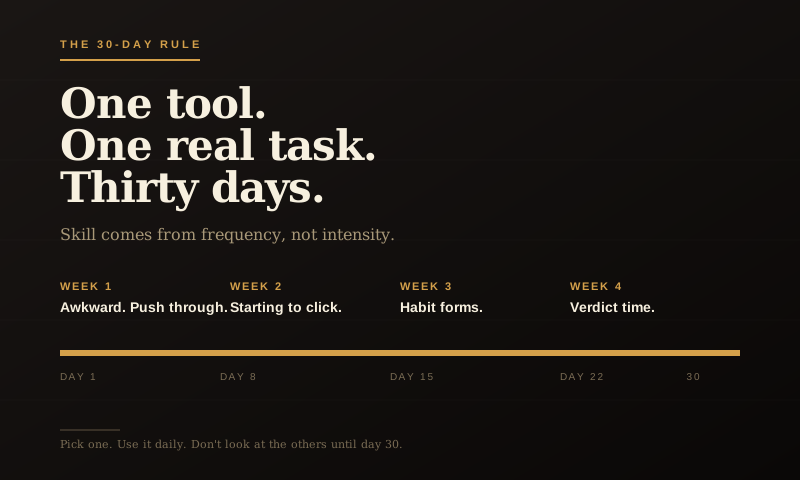
That's where most second-act ideas die. Not because the idea was bad. Because nobody actually wanted it badly enough to do something about it. Better to find that out in 30 days than 30 months.
Step four: Use AI for the grind, not the judgment.
Once you've found a real signal, a few people said yes, a few people opened the email, somebody handed you money, AI becomes the unglamorous workhorse.
It can draft the outline of your offer. It can compare three competitors. It can organize the notes from your customer conversations into a coherent document. It can suggest pricing tiers and explain why. It can build the checklist for what to do this week. It can write the boring follow-up email so you actually send it.
What it cannot do, what you should never let it do, is decide whether the idea fits your life.
That decision is yours. Whether the work gives you energy at the end of the day or drains it. Whether the people involved are people you want to spend time with. Whether this fits next to your marriage, your friendships, your health, the trip you've been putting off, the time you actually want to spend with your grown kids. The AI doesn't know any of that. You do.
The trap to avoid.
The number one mistake men make in their second act is building another job they resent.
You retire from the corporate grind, you swear you're going to do something different, and six months later you're back to working sixty-hour weeks for a business you own, same stress, less money, less benefits, and now there's nobody to complain to because the boss is you.
The whole point of the second act is to design something different. Not necessarily smaller, not necessarily slower, but different, built around what gives you energy at this stage of your life, not what gave you energy at 32.
So when you use AI in this process, keep asking it questions about fit, not just opportunity. "Is this a good business" is the wrong question. "Is this a good business for the kind of life I'm trying to build over the next ten years" is the right one.
The starter sequence.
If you do nothing else, do these three things this week:
- One AI conversation. The interview prompt above. Forty-five minutes. Read what comes back.
- One conversation with a real human. Someone five to ten years ahead of you who's already in some version of a second act. Ask them what they'd do differently.
- Write one paragraph. Not a business plan. A single paragraph that finishes the sentence: "If I'm being honest, the next chapter probably looks something like…"
That's the whole playbook. Inventory. Pressure-test. Small experiment. Use AI for the grind. Decide for yourself what fits.
Most second acts don't fail because the idea was wrong. They fail because the guy never actually started, or because he built the wrong thing for the right reasons. AI doesn't fix that. But it does take the friction out of the part where you sit and stare at a blank page wondering where to begin.
Begin. The page doesn't have to be blank for long.